
Leans into the emotional and philosophical layer. Suggests persistence without clarity or resolution.
“My mind is shrouded in a cloud of distress. Though I remain sovereign, hope flickers. The unrelenting noise of life continues its flow.”
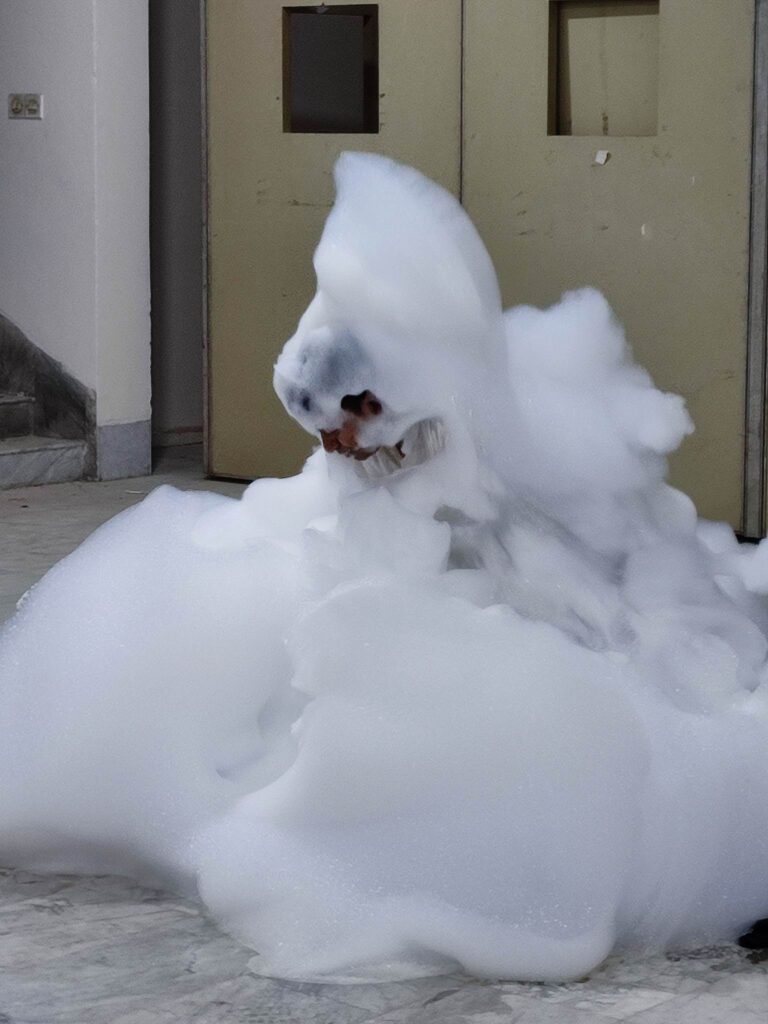
In Endurance in Obscurity, the body does not perform — it endures. It is submerged.
Standing at the centre of a vast white field of expanding foam, the performer disappears into a cloud of its own making — a dense, living mass rising from a dark ground beneath. What the image reveals is not spectacle, but condition: a human figure partially consumed, partially resisting, caught in the threshold between presence and erasure. Around the periphery, witnesses hold still. The foam does not.
This work continues my long-term investigation of the body as a site where invisible forces accumulate and take form. My practice is rooted in lived experience, cultural consciousness, and spiritual inquiry — not in representation, but in the act of entering a condition that cannot be adequately named, only inhabited.
The foam is the central material agent of this work. It is not merely symbolic. It expands beyond intention, clings to skin and cloth, distorts the body’s outline, and disrupts spatial orientation. It is simultaneously weightless and suffocating — immaterial in appearance, yet dominant in effect. In this way, it mirrors the accumulated forces of psychological pressure, social expectation, and interior grief: things that appear insubstantial, yet gradually overwhelm.
The black ground beneath — visible at the edges where the foam has not yet reached — establishes a field of contrast. Darkness contained. Whiteness overflowing. The body exists between them, neither fully consumed nor fully free.
Movement in this performance is not choreographed. It emerges through resistance. The body searches for orientation within the cloud, navigating through slow, repetitive, and interrupted gestures. Each action becomes an effort to reclaim presence — yet that effort is perpetually challenged. This is the central tension the work inhabits: not a struggle toward resolution, but a sustained negotiation with obstruction.
Repetition here is not decoration. It is a method. Through sustained physical engagement, habitual structures of identity and control begin to loosen. The ego — typically reinforced through intention and social positioning — is gradually destabilised. What remains is something more elemental: a presence rooted in endurance, not power.
This resonates with my ongoing dialogue with spiritual and philosophical traditions — Sufi thought, Zen, and the broader current of mystic inquiry across cultures — where the body is understood as a temporary vessel, capable of entering states beyond ordinary cognition. Yet Endurance in Obscurity does not resolve into transcendence. The body does not escape the cloud. It continues within it.
Hope, in this work, is fragile and without declaration. It persists not as clarity, but as the simple, stubborn fact of remaining.
The audience stands at the edge — as the witnesses in the image stand — observing a body in continuous negotiation between concealment and emergence, surrender and awareness. There is no narrative arc. No catharsis offered. The work unfolds as a durational condition, and meaning, if it arrives at all, comes through time.
Endurance in Obscurity asks a fundamental question: when the body is placed within sustained resistance and uncertainty, can it access a form of sovereignty that is not built on control, but on presence — not beyond the obscurity, but within it?
This performance is part of an ongoing series in which physical action becomes a means to confront and transform the invisible structures that shape human existence.


