In your light, I learn how to love
in your beauty, how to make poems.
You dance inside my chest
where no one sees you,
but sometimes I do —
and that sight becomes this art.
— Rumi
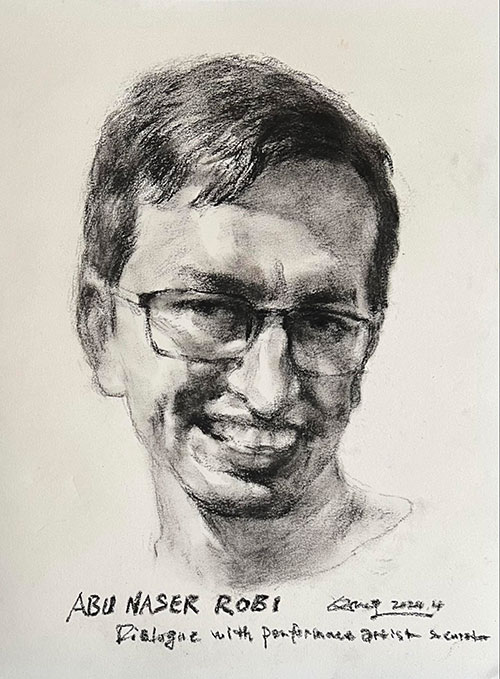
Creating imagery is always mysterious. It emerges from the process of daily living, beliefs, and ethnic existence. My drawing, painting, and performance activities present an imaginary space that is beyond reality — one that speaks to the autonomous existence of human spirits in a universe that is shapeless and infinite.
I was born in 1975 in Patenga, Chittagong, a coastal landscape where the sea, rivers, and human resilience intertwine. Shaped by the rhythms of nature, migration, memory, and the cultural hybridity of southeastern Bangladesh, I came to understand early that art is not separate from life — it is life made visible. My formal training culminated in an MFA in Drawing and Painting from the University of Chittagong, yet my true education has unfolded through lived experience, spiritual inquiry, and sustained engagement with communities across borders and disciplines.
My practice moves fluidly across drawing and painting — acrylic on canvas, watercolour, oil pastel, lino-cut printmaking — as well as performance art, installation, and socially engaged work. Whether through contemplative oil-pastel landscapes such as *Road and Life* (2025) or body-based performances that frame the body “to occupy space in a fragment of time,” I seek to dissolve the ego and enter a transcendental condition. The body, so often invested with egotism in daily life, becomes in performance a site of impersonality — an instrument capable of moving beyond individual narrative to address urgent collective realities: the destruction of nature, ecological fragility, social fragmentation, and the quiet erosion of community under the pressures of modernity.
The spiritual traditions that illuminate my practice are not worn as doctrine but lived as inner climate. Sufi thought — particularly the poetry of Jalaluddin Rumi — and Chinese Zen occupy luminous, complementary places. Rumi’s vision of the unseen dance within the chest, the hidden beloved who manifests as form, reveals creation as an act of love and surrender. Sufism’s movement toward the dissolution of ego (*fana*) and absorption into the infinite (*baqa*) finds resonance in Zen’s embrace of emptiness (*mu*), direct insight, and boundless awareness. In performance, the body becomes an empty vessel through which the shapeless and infinite may appear. In painting, a quiet economy of means evokes vastness through what is left unsaid — much like the pregnant emptiness of Zen aesthetics (*yohaku*). Along the coastal horizon of Patenga, where sea and sky dissolve into one another, I encounter this as a daily meditation on impermanence and interconnectedness. Indian mythological cycles, Islamic and Christian lore, and the broader current of South Asian spiritual life complete this syncretic field — not as orthodoxy, but as multiple lenses through which to interrogate our present condition.
Art, for me, is communication rather than a commodity. It is a bridge between the visible and the unseen, the finite and the boundless.
In 2004, I founded **Porapara Space for Artists** in Patenga, Chittagong — an artist-led initiative conceived as a living laboratory for experimentation, critical dialogue, and inclusive practice. As chairman, I have guided Porapara through more than ninety-five events: workshops, residencies, exhibitions, and community-driven projects such as *Floating Peers* (2013), which connected coastal communities of Chittagong with artists from South Korea, Japan, Nepal, Jordan, and Finland. After a period of necessary pause, Porapara has relaunched with renewed commitment to performance art as open, experimental territory. Its founding conviction remains unchanged: art can change life.
My international journey — through residencies in South Korea, Japan, Jordan, and Nepal, and exhibitions at the Asian Art Biennale, Dhaka Live Art Biennale, Chittagong Open Art Biennale, and solo presentations including *The Tale of Darkness* — has deepened this conviction. Each encounter has reinforced my belief that art can transcend borders while remaining firmly anchored in the specificities of place, body, and spirit.
My practice is neither purely autobiographical nor a detached spectacle. It is a sustained meditation on the mysterious autonomy of the human spirit within an infinite, shapeless universe. Through every stroke, gesture, and curated encounter, I seek to evoke a visceral awareness of our interconnectedness — with nature, with one another, and with the boundless that lies beyond the visible. Art remains, for me, daily ritual, social commentary, spiritual inquiry, and quiet resistance. It invites viewers not merely to observe, but to enter an imaginary space where the finite meets the infinite — and where the human spirit asserts its enduring freedom.
Abu Naser Robii
Dhaka, Bangladesh | 2026