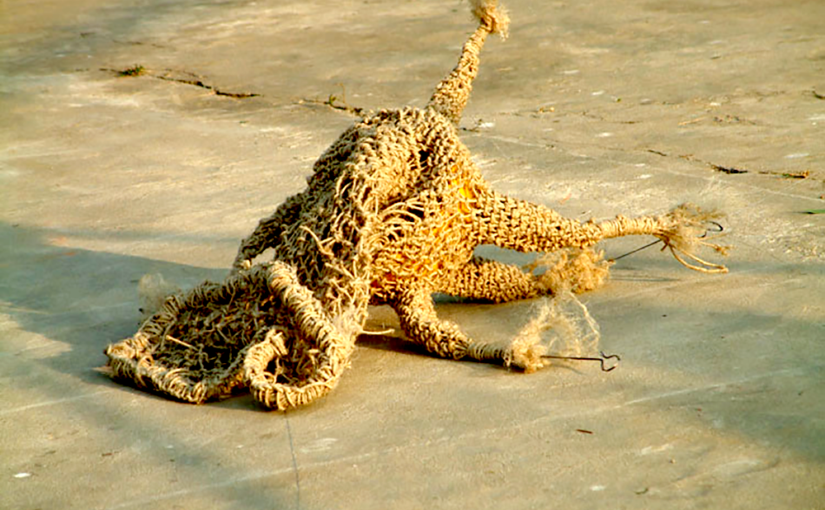
Explore the conflicts that shape our world, including those between existence and non-existence, large and small, and power and inability. Recently, I participated in a 10-day art workshop in a secluded ashram, where we explored the integration of the body, usable objects, time, and space to express human existence and feelings. At the workshop, I created a weaving of a neuron cell to represent the unit of invention and discovery within our minds, revealing tensions between speed and status and new interpretations. My art seeks to embody conflicts and tensions in new and meaningful ways.

I see the world as a place of constant conflict and balance. From the tension between existence and non-existence to the struggle between power and inability, our world is built on a delicate equilibrium of opposing forces. At times, this balance can collapse and turn everything upside down. But in this game of destruction and creation, conflict is essential for growth and progress.
Recently, I participated in a 10-day art workshop held in the peaceful Jagatpur Ashram in Raujan, Chittagong Along with other young artists, we explored the idea of integrating the body and its objects, time, and space to express human existence and feelings. We questioned whether movement could become sculpture, and how we could convey our emotions in a spontaneous yet planned manner.
During this workshop, I was going through a turbulent time in my personal life. I had just finished my studies in fine arts and started working, with an uncertain future ahead of me. But amidst all these doubts and fears, I found solace in the workshop\’s exploration of a new way of visual art.

At the entrance of the ashram, I noticed an electricity tower and my thoughts turned to the struggle for survival and the non-existence of self. With the idea that all the inventions and discoveries of the world are inside a tiny neuron cell that allows us to think, we created our own research and thoughts on this site.
We wove together a neuron-like object using bamboo and electric poles, representing the game of neurons at the root of all creation. In the center of this creation were me, a traveler with an aimless destination, a desire to go and to be, and a static being in the multi-directional tension of history and tradition. The conflict between speed and status was expressed through bodily actions, while objects and forms were transformed to create new interpretations in response to the present viewer.
This movement was later repeated in Dhaka\’s Alliance Francis Gallery, where we shared our experience with the local audience. The workshop director was so moved by the weaving process that he incorporated it into his own movement during the event. It was a memorable evening and the beginning of a new journey for all of us.
As an artist, I believe that our world is built and sustained by balancing countless conflicts – between existence and non-existence, large and small, power and inability. These conflicts drive the game of destruction and creation that underlies all of our existence. Recently, I had the opportunity to participate in a 10-day residential art workshop with French artist Ayona Coaznai and Bangladeshi artist Mahbubur Rahman at Jagatpur Ashram in Rawjan, Chittagong. The workshop aimed to explore the integration of the body and usable objects, time, and space to express human bodily existence and emotions as an extension of the sculptural or monumental images of its.
As a recent fine arts graduate and new artist, I felt both lucky and apprehensive about being part of this research. Amidst personal turbulence and uncertainty, I engaged in soul-searching discussions with fellow artists, exploring new ways to express visual art. At the entrance to Jagatpur Ashram, I was struck by the electricity tower and its presence as a symbol of survival and struggle.
The workshop\’s originality lay in its creation of a site for research that drew inspiration from the idea that all the world\’s inventions and discoveries are contained within the unit of a single neuron cell that enables us to think. I explored the conflicts that lie at the root of all creation, seeking to embody them through certain movements in specific times and spaces.
To this end, I wove a neuron into a string of jute, with each node representing a single neuron. The transformed form of the neuron cell in my head became the central object, with its different ends covered with different corners of the huge electric poles, connected by an invisible thread. The weaving was inspired by cultural and traditional bamboo weaving, and it represented me – a traveler of an aimless destination, a desire to go, a desire to be, and a static being in the multi-directional tension of history and tradition.
My bodily actions expressed the conflict between speed and status, changing familiar forms and creating new interpretations in response to the present audience. This was the beginning of a different journey that inspired the workshop director Mahbubur Rahaman to make a movement to strengthen the idea by himself with the help of my weaving at the same event in Dhaka\’s Alliance Francis Gallery. The evening was memorable, and I look forward to continuing to explore new ways to express the conflicts that drive our world.


