Concept: The art installation and performance are a response to the artist\’s experience during their residency at the Uijae Artist Residency in Gwangju, South Korea. During their stay, the artist visited a historic building that was significant in the country\’s democratic uprising of May 18, 1980. This experience led the artist to reflect on the complexity of history and the subjective nature of its interpretation.
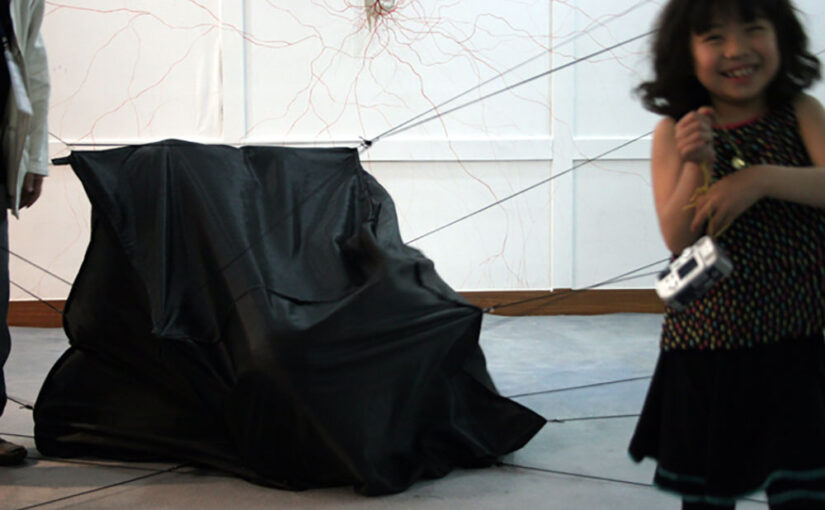
The installation consists of a network of red lines resembling the blood vessels of the human body, spreading out around bullet holes found in the designated rooms of the historic building. The lines represent the interconnectedness of people and the shared experiences of pain and sacrifice. The documentary on May 18 is projected on another wall of the room, highlighting the significance of the location and the event.
Performance: The performance lasts for 30-45 minutes and takes place in a black cloth box-like form placed in the middle of the exhibition room. The performance is set to the rhythm of the patriotic song of May 18, emphasizing the emotional and national significance of the event. The artist changes the forms within the box, creating a visual representation of the transformative nature of history.
Explanation: \”Let Me Know the History Behind the Story\” is an exploration of the subjective nature of history and the interconnectedness of people across time and place. Through the use of red lines, bullet holes, and performance, the artist invites the audience to reflect on the complexity of history and the human experiences that shape it. The performance emphasizes the emotional impact of historical events, reminding us that we are all connected by our shared humanity.
\”Cross-Cultural Collaborative Performance\” is a collaborative and participatory performance art piece created by a group of diverse artists during a three-month residency at the Uijei Art Museum in Gwangju, South Korea. The performance took place on May 18, 2007, at the beginning of the open studio event, and was attended by a large audience, including the mayor of Gwangju, administrative officials, and officials from the South Korean Ministry of Culture.
During the residency program, the artists engaged in extensive discussions on various art, life, cultural, and political issues, exchanging opinions and debates. This collaborative performance was a result of one such discussion, where Thai artist Sorachai Ekpalakorn, Korean artist Gino Park, Abu Naser Robii, and the main curator and director of the residency, Kyong Paik, talked about the cultural experience of their respective countries, the relationship between culture with political and historical issues, religion, and the connection of human nature and natural environment with spirituality, among other topics.
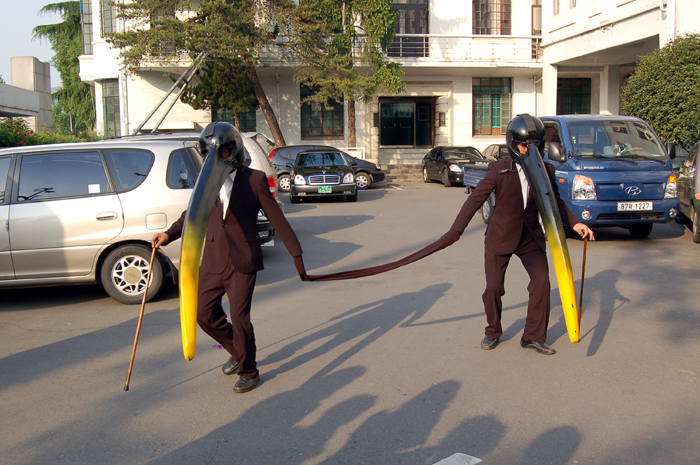
The performance involves the creation of symbolic figures and costumes that represent the essence of the artists\’ discussion. The Thai artist creates a fish head mask, which he wears while walking blindly with a cane in one hand, highlighting the limitations of human consciousness and our entrapment in ethics and religion. The Korean artists, on the other hand, create two hummingbird heads, wearing a whimsical outfit made by combining one sleeve of black and white Korean government officers\’ clothing.
Together, the artists perform a path towards Gwangju Square, making strange noises and creating a metaphor of the handsome and big-lipped Korean politician as a symbol of Korean political culture, expressing the ironic numbness of various steps of politics. Sorachai\’s fish mask and trauma to his head also critique the social and political leadership, creating a sense of lost consciousness.
\”Cross-Cultural Collaborative Performance\” is a unique experience that showcases the power of cultural exchange and collaboration among artists from different countries and backgrounds. It highlights the importance of discussions on various issues, leading to the creation of thought-provoking art that critiques social and political issues.
During my artist residency experience in Mudungsun Mountain, Gungju city, South Korea, I had the opportunity to explore the connection between prayer, mountain climbing, and happiness. After a harsh winter, I was struck by the beauty of the new leaves and colorful wildflowers that had emerged and felt extremely happy after each visit. However, this also led me to question why I and many others enjoy climbing mountains. I observed that people of all ages visit mountains in their free time and that many Buddhist temples are situated on mountaintops.
Drawing from my own experiences with Muslim prayer systems and scientific meditation in university, I researched various established methods of meditation, the process of sexual orgasm, eastern and western classical music, traditional Korean music, and other phenomena of life that can make us happy. I found similarities in the physical and mental processes that lead to happiness and wondered if the physical act of performing an action is important to make us happy, how our mind gets involved with the process, and whether it needs to be distant from the body to feel happiness.
I visited the mountain and temple every day and was surprised by how the nature and process of climbing combined with me, leading me to experience some unusual moments that are not possible on plain land. I asked some artist friends to help me develop my project, and together we explored the effects of mountain climbing on the mind and body. Through our visits, we observed that the physical tiredness of climbing made a distance between the body and mind, while the expanding horizon line had an effect on our mind to open it up.
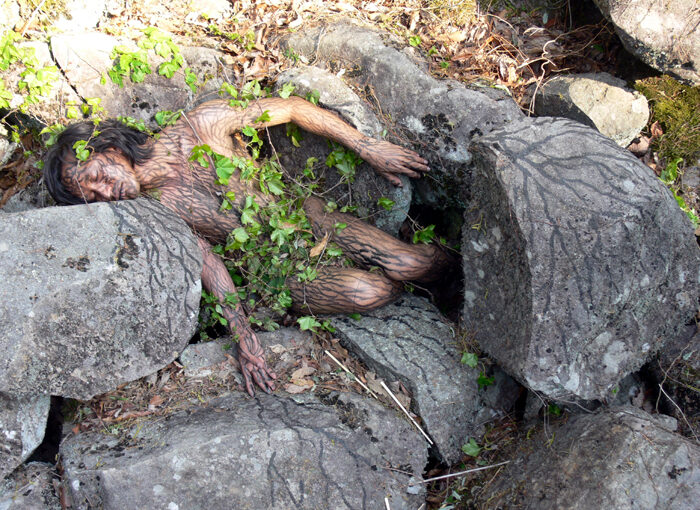
As we climbed the mountain with our friends, we found that our relationships changed after each visit and that we gained a deeper understanding of ourselves and our relationships. We wondered if the physical act of climbing and the consciousness of stepping helped fulfill the process of happiness. This exploration culminated in a prayer performance on Mudungsun Mountain, which we documented and presented in a gallery space to share our conceptual process with others.
Overall, my experience climbing Mudungsun Mountain led me to question the link between prayer and mountains, explore the mechanisms of climbing mountains, and question what makes us happy. Through this exploration, I gained a deeper understanding of the connections between physical and spiritual happiness, and the transformative experience that can result from the act of climbing a mountain.
During my three-month residency at Mudung Mountain Studio, I embarked on a new artistic project titled \”Searching for the missed mystery of Life and Happiness\”. The project aims to visually explore the relationship between nature, spirituality, and happiness, and understand the mechanisms that encourage people to be drawn to supernatural beings and phenomena.
To accomplish this, I plan to use a variety of creative visual practices, including live performance, video, photography, drawing, music, and painting with simplified installations. My focus will be on my thoughts and inner feelings about interpersonal and socio-life, as well as the crossroads of artistic practice, personal expression, experimentation, and risk points.
The project\’s catalyst note is a passage by Khalil Gibran about prayer, which has guided my exploration of the connection between prayer, nature, and happiness. My goal is to create a conceptual world that will serve a new epoch and to present my work in a way that is easy and communicative to non-artist audiences.
Through this project, I hope to provoke reflection and exchanges around the process of creation, form a notion of sculpture as a live presence, and occupy space for a fragment of time. It will be an immersive experience that takes the audience on a journey through the unknown, encouraging them to approach sculpture through installation and performance, feel sensations, and listen to movement.
Ultimately, the primary objective of this project is to uncover the mysteries of life and happiness and present them through the visual arts.